Property Damage Restoration & Reinstatement
If your property has been affected by an escape of water, flood, storm event or other insured peril, Peak Projects can manage the process from initial response through to full reinstatement.
Services
What we do
Assessment & Mitigation
We attend site to assess the extent of damage, identify affected areas, and establish the immediate steps required to prevent further deterioration. Early mitigation is essential to limit secondary damage, reduce disruption, and support the insurance claims process.
Strip-Out Works
Where materials are beyond repair or preventing effective drying, we coordinate controlled strip-out works. This may include the removal of damaged flooring, plasterboard, insulation, fixtures, fittings and finishes, while retaining as much of the existing building fabric as possible.
Project Management
We provide a single point of contact throughout the process, coordinating contractors, specialists, insurers and loss adjusters where required. Our role is to keep the project moving, provide clear communication, control costs, and ensure the works are completed safely, efficiently and to the required standard.
Drying & Monitoring
We arrange and manage targeted drying programmes using specialist equipment and moisture monitoring. Regular readings help confirm progress and ensure that reinstatement works only proceed once the property has been suitably dried.
Reinstatement
Once drying is complete, Peak Projects manages the reinstatement works required to return the property to its pre-incident condition. This can include repairs to walls, floors, ceilings, joinery, decorations, services and finishes.
Equipment
Drying Technologies
Refrigerant Dehumidifiers
Typical applications:
- Residential properties
- Commercial buildings
- General structural drying
- Surface and ambient moisture removal
Desiccant Dehumidifiers
Typical applications:
- Heritage and listed buildings
- Low temperature environments
- Deep structural drying
- High-value properties and sensitive environments
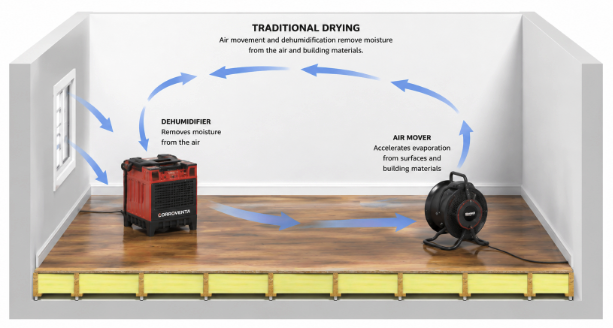
Traditional Structural Drying
Suitable for:
- Plaster walls
- Timber floors
- Decorations and finishes
- General building fabric
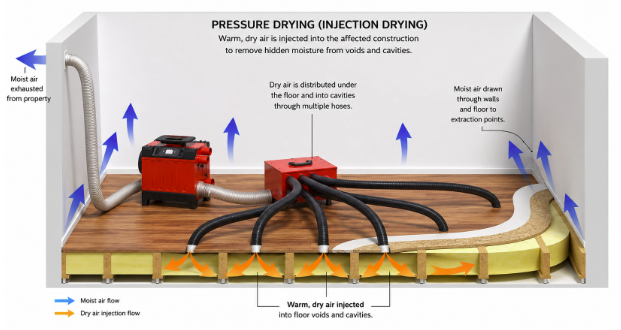
Pressure Drying (Injection Drying)
Benefits:
- Faster drying of concealed moisture
- Reduced strip-out requirements
- Less disruption to occupants
- Preservation of building fabric
- Reduced reinstatement costs
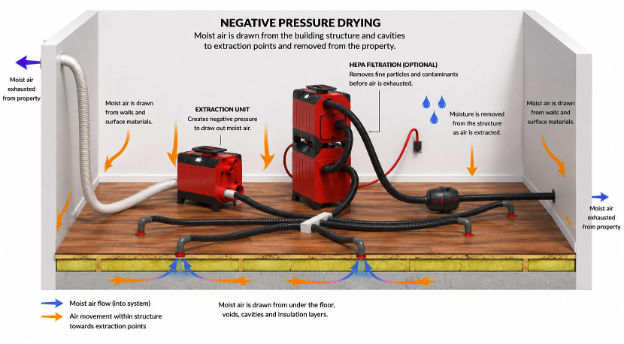
Negative Pressure Drying
Benefits:
- Effective drying of enclosed cavities
- Controlled moisture extraction
- Reduced risk of spreading contaminants
- Suitable for sensitive environments
Selecting the Correct Drying Method
Specialist services
Moisture Monitoring & Drying Verification
Regular monitoring provides a clear record of drying progress and helps verify that moisture levels are reducing as expected. The collected data can be reviewed by contractors, insurers and loss adjusters, providing an evidence-based approach to moisture management and drying verification. Remote monitoring systems also help reduce energy consumption by ensuring equipment operates only for as long as required to achieve the specified drying targets.
Before reinstatement works commence, final moisture assessments are undertaken to confirm that the affected building materials have returned to acceptable moisture levels. This ensures that repairs are carried out on a properly dried structure, reducing the risk of future defects, mould growth and moisture-related damage.
Assessment → Monitoring → Verification → Reinstatement
By combining traditional site inspections with modern moisture monitoring technology, Peak Projects delivers a data-driven approach to water damage restoration, providing confidence that drying has been completed efficiently, effectively and to the required standard.
Trace & Access
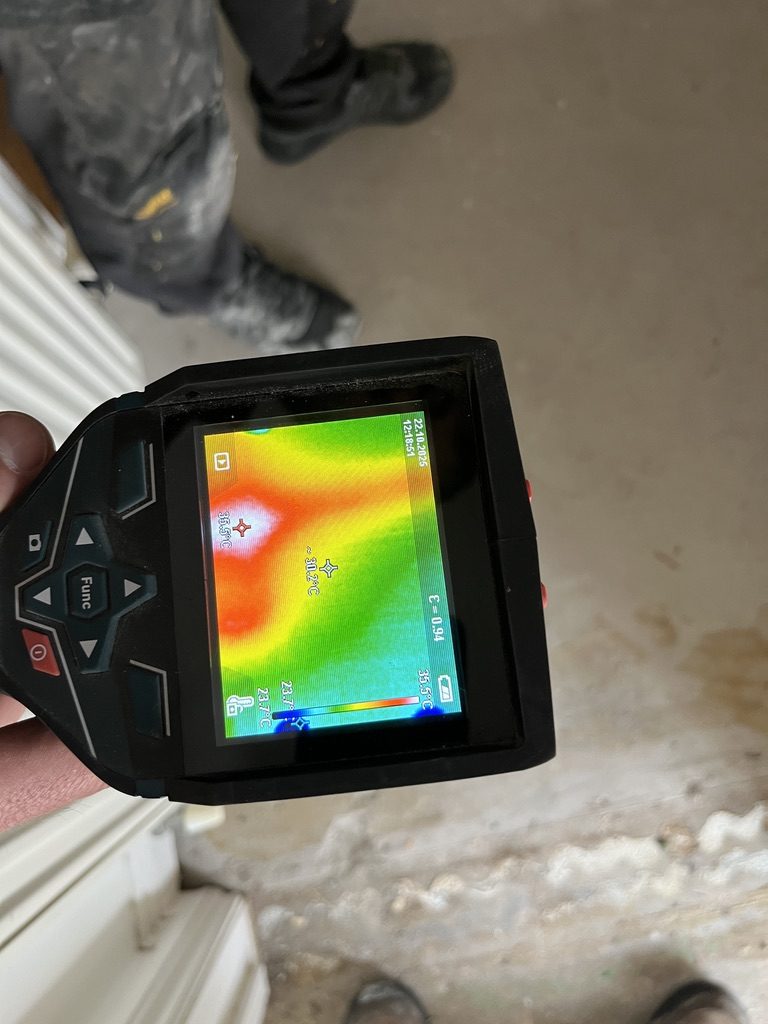
Identifying the source of a leak is often the first step in preventing further damage and progressing an insurance claim. Peak Projects provides trace and access services to locate hidden leaks and identify affected services with minimal disruption to the property.
Using a combination of thermal imaging, moisture mapping, visual inspection and practical building knowledge, we investigate water ingress affecting walls, floors, ceilings and concealed building elements. Our experience allows us to identify likely leak sources and determine the most effective access strategy before any intrusive works are undertaken.
Our objective is to accurately locate the source of the problem while minimising unnecessary damage, disruption and reinstatement costs.
Reinstatement
Building reinstatement
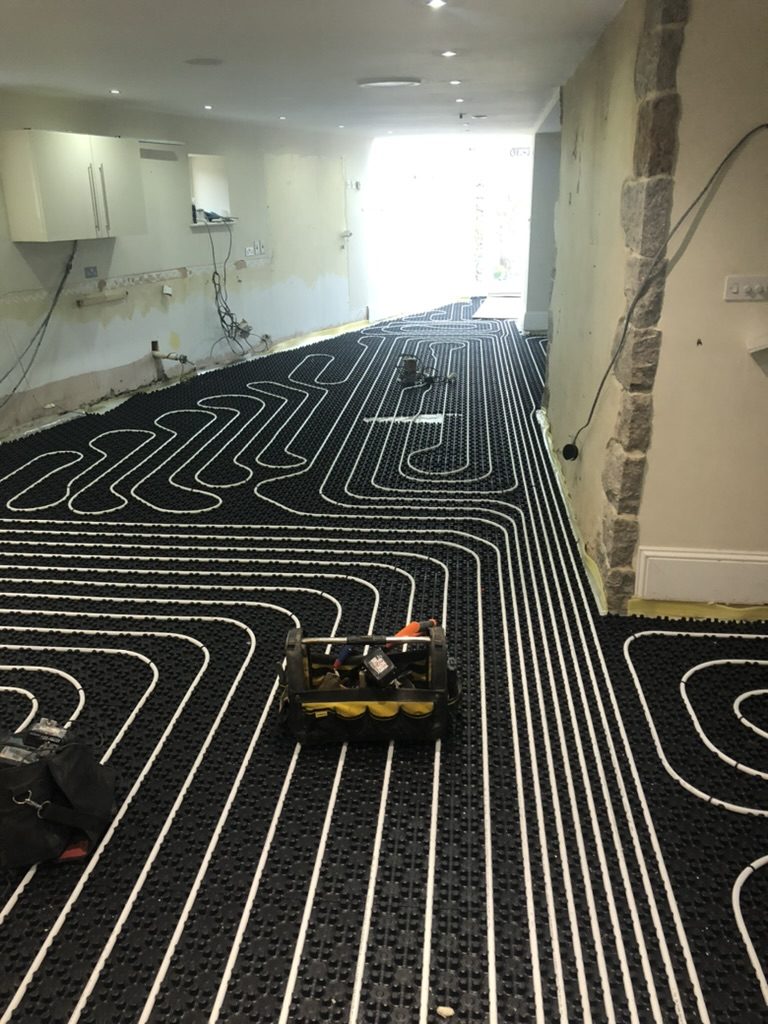
When a property suffers damage as a result of an escape of water, flood, fire, storm, impact, subsidence or other insured event, managing the recovery process can be complex and time-consuming. Multiple contractors, drying specialists, insurers and consultants may all be involved, often resulting in delays and uncertainty for property owners.
Peak Projects provides a complete insurance reinstatement solution, managing the process from initial assessment through to the successful completion of repairs. Acting as a single point of contact, we coordinate all aspects of the project, including damage assessment, leak detection, moisture management, drying, repair specification, contractor procurement and reinstatement works.
Our experienced team works alongside a trusted network of approved contractors and specialist trades, enabling us to deliver both emergency response and full reinstatement services. Whether the project requires drying specialists, plumbers, electricians, builders, decorators or structural repairs, we assemble and manage the appropriate team to deliver the required outcome.
By combining technical expertise with professional project management, we ensure that repairs are properly scoped, drying is verified, contractors are coordinated efficiently and works are completed to the required standard.
For independent building surveying and insurance reinstatement consultancy, see Peak Surveying Services.
Enquire
Submit your project details
Provide the property location, nature of damage, and insurer reference if known. We will respond within one working day.